In the recent couple of years there has been steady development in areas of non-relational data storage, where in the data does not fit into a more orderly schema instead the data tends to have flexible schema. These center around the recent developments in social media and social networking where in enormous amounts of data is being stored and retrieved. Since the vendors/companies in social networking space did not find traditional RDBMS to suit their needs, the emergence of NoSQL systems took place. NoSQL means "Not only SQL". These systems (NoSQL) have flexible schema,Massive scalability (since lot of requests can be handled in parallel) and higher performance and availability. There are different implementations of NoSQL Systems, they are:
1. MapReduce FrameWork.
2. Key-Value Stores
Example Systems: Google BigTable,Amazon Dynamo,Cassandra.
3. Document Stores.
Example Systems: CouchDB,MongoDB,SimpleDB.
4. Graph Database Systems.
Example Systems: Neo4j,FlockDB,Pregel.
The MapReduce Framework is kind of analogous to OLAP in the Business Intelligence world, the Key-Value Stores can be kind of analogous to the OLTP world. Document Stores use a Key,Document pair to persist documents and also enables faster retrieval of documents, one of the popular systems which implements Document Store is MongoDB.
One of the popular implementation of NoSQL system is the MapReduce Framework which was originally developed in Google, then followed by the Open Source implementation called Hadoop. This Map Reduce has No Data model, the data is stored in files on the Google File System (GFS) or the Hadoop file System called HDFS. There are specific functions in this Framework such as Map(),Reduce(),Reader(),Writer() and Combiner(). Microsoft has plans to work with Hadoop in some form, the NoSQL has been gaining traction in the last couple of years and this space is bound to see a lot of changes in the coming years. I would to thank Prof. Jennifer Widom (Stanford University, Computer Science) for providing information/material on NoSQL Systems as part of a online course in database systems.
Monday, December 5, 2011


Friday, December 2, 2011
Visual Studio 2010-SQL
Recently I started using Visual Studio 2010 Professional Version. There are lot of new features in VS 2010 which goes without saying. One of the areas which i frequently work on is databases. There is a lot of integration between VS 2010 and the upcoming SQL Server 2012 version. Once a connection is established to a SQL Server using the server explorer, one can view the objects within the database in the server explorer. In the menu option Data when you choose Transact-SQL Editor, at first you are asked to log in to SQL Server, once logged in the query window opens up just like the one in SQL Server Management studio. There is a option Database next to which one can see the current database you are connected to. This feature comes in handy when there is development going on in a VS 2010 environment and at the same data needs to be explored. The integration between VS 2010 and SSMS seems very close in VS 2010.

When a query is written, it can highlighted and when the right click on the mouse is pressed, one can see a popup menu being displayed.


When a query is written, it can highlighted and when the right click on the mouse is pressed, one can see a popup menu being displayed.

Wednesday, November 30, 2011
SSIS LookUp Task...
In SSIS one of the tasks used for incremental data loading/updating is Lookup task, of course depending on the scenario. In the look up task one of the properties/settings that can be customized is the cache mode. A good understanding of the cache mode helps one design better packages utilising lookup tasks. Here is an article though published in 2008 gives a very good insight into the different cache modes. This article is by Matt Masson,http://blogs.msdn.com/b/mattm/archive/2008/10/18/lookup-cache-modes.aspx. It breaks down different cache modes and explains the use of each of them.
Monday, November 21, 2011
Isolation Levels...
When working with a relational database management system , it is very important to understand the concept of isolation levels. The isolation levels become even more important while working on transactional database systems. The isolation levels might seem very basic but it effects are more paramount as one starts to view the big picture especially a critical transactional database. It is very important to provide consistency and concurrency for the users of the transactional system. There are some basic isolation levels which are provided in SQL Server:
SET TRANSACTION ISOLATION LEVEL READ UNCOMMITEDSET TRANSACTION ISOLATION LEVEL READ COMMITED (the default setting in SQL Server)SET
SET
There are some newer isolation levels provided in more recent versions of SQL Server. I visted a older article but very relevant as one dealing with transactions, here is the link: The article has been written by Kalen Delaney, she is a sql server expert:http://www.sqlmag.com/article/tsql3/transaction-isolation-levels
I would encourage one to try out the examples in the article, it gives a good understanding of how isolation works. TRANSACTION ISOLATION LEVEL SERIALIZABLE. TRANSACTION ISOLATION LEVEL REPEATABLE READ
Tuesday, November 15, 2011
Database Master
The main tool i typically use is the SQL Server Management studio for working with queries. Recently i came across a tool which i needed since i had to work with SQLLite/MySql databases. The name of the tool is called Database Master which has been developed by Nucleon Software, the web site is http://www.nucleonsoftware.com/. The software is available for download with a 30 day free trail. One of the neat things about this tool is the ability to connect to variety of data sources, they include MongoDB, a document based database,
SQL Server,Oracle,MySQL,PostgreSQL,SQLLite,Netezza,db2,Ingres,dbase,XML,Firebird,Foxpro and dbase. As one can see that this is a pretty exhaustive list of databases. Once a connection profile is established, it provides a Object Explorer/query window type interface just like the one in SSMS. It is a pretty light weight tool. The tool has options for working on LINQ based qery as well. There is a snapshot of the UI given below.

One of the USP of this tool is the ability to connect to a variety of data sources, i found this useful in my ETL project where i need to connect to a variety of data sources and need to examine the data.
SQL Server,Oracle,MySQL,PostgreSQL,SQLLite,Netezza,db2,Ingres,dbase,XML,Firebird,Foxpro and dbase. As one can see that this is a pretty exhaustive list of databases. Once a connection profile is established, it provides a Object Explorer/query window type interface just like the one in SSMS. It is a pretty light weight tool. The tool has options for working on LINQ based qery as well. There is a snapshot of the UI given below.

Thursday, November 10, 2011
SSIS-Error Messages
There are situations/circumstances where one runs/debugs a SSIS package in the BIDS/Visual studio environment, one would encounter errors. In the progress tab we can see what steps have been performed in the SSIS package and at time we see lenght error messages. The error messages tend to be not visible entirely in the Progress tab. This could make it difficult for one to understand what the message is and proceed with the debugging process. Here is a snapshot of the progress tab within BIDS.
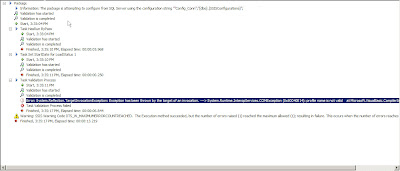 In order to get the full text of the error message , highlight the message and do a right click, the option Copy message text shows up, click on it and one can paste it from the clipboard into a editor like notepad/word to get the full message.

This has helped me in lot of situation when i had to deal with sometimes cryptic error messages.


This has helped me in lot of situation when i had to deal with sometimes cryptic error messages.
Wednesday, November 9, 2011
Ethics & Presentations
In the SQL Server Community today there are lot of presentations being made in conferences, as part of learning and teaching courses. One of the main aspects of presenting to a technical audience such as SQL Server requires adhering to certain discipline and ethics while presenting content. At times i have heard about folks using profanity in presentations to get attention of the crowd or to sell themselves as very cool in front of audience, well this doesn't work in a technical audience i think. Thanks to http://www.sqlservercentral.com/, i am posting a link to Scott Hanselman's blog:
http://www.hanselman.com/blog/ProfanityDoesntWork.aspx
I felt that the content presented here is very relevant and brings out good points on what needs to be and what needs to be avoided in presentations.Hope this provides an enjoyable read. I feel that one needs to well research the material and be prepared fo questions from the audience. When the content being delivered is good, the audience will be drawn into the speaking event.
Subscribe to:
Posts (Atom)